
In a world of globalization and exchange of information at a fast pace, it seems impossible to live without modern technology. My question is, how many of us are using technology in classroom to conduct action research projects that engage students?
In a course I am currently taking, one of my group partners, a secondary teacher, is sharing pictures of Vietnam war through voicethread (voicethread.com).There are American and Vietnamese soldiers and Vietnamese people in those pictures. The teacher asks her students to narrate a story by pretending to be a character from those pictures. I agree that this is a brilliant idea to know a historical event by bringing characters in history to life and getting students engaged. However, my first thought is what if there are biases and stereotypes? There might be students who chose to be Vietnam soldiers, but still they are not from Vietnam and it is highly possible that they judge the history based on their life and imposed American values. Is there a way to bring voices from Vietnam?
I even began to imagine a solution – that if there is collaboration between schools in America and in Vietnam on this Vietnam War project, students from both sides will be able to express their opinions when acting as certain characters in the pictures. By doing so, we now have voices from Vietnam in which the event actually occurred.
This might sound like a fantasy because history, even as a fact, allows different interpretations and perspectives. However, my point is, since technology is right at hand, why not we make the best use of it? A principal in an elementary school in China asked me the other day if I have an idea to let her students know more about elementary students in America. She was considering creating a program that can let her students visit America every year. I was shocked by her thought because I do not know how to take care of children around 8-13 years old who can only say ‘Hello' and 'How are you?' So maybe the Internet and technology are the best way for a start.
Showing posts with label classroom action research. Show all posts
Showing posts with label classroom action research. Show all posts
Tuesday, June 29, 2010


Tuesday, June 15, 2010
The Action Research Train
This week I have asked a colleague to contribute to our discussion of action research and education. Adam Cooper is an action researcher and an educator working towards completion of his doctorate at the University of Cincinnati. He has an amazing ability to draw out what is really happening in situations, has tremendous expertise in his field, and is an exceptional teacher. I hope his post today will generate some movement or reflection-or both.
From Adam:
I'd like to answer Dusty’s call for some metaphorical analyses of our work in action research. And so, as an educator, it seems apropos to consider mass transit, and particularly, to think about the train.
From all over the world and all over our society, we come together in the public schools to depart on a journey together. The assorted mix of interests that drive our educational system are so varied, sometimes so disparate, that it’s easiest to become reclusive. We jump on the train car together and pack ourselves in, but we seldom interact with anyone but those who boarded with us. Schools resemble a packed elevator, too, where numerous people are confined in a small space, but they rarely even acknowledge each other’s presence. It’s unnatural and it limits our potential.
Action research opens up the confined space; it facilitates interaction; it pushes all parties to reach their natural potential simultaneously.
I came into the Action Research fold by way of Kumaravadivelu (2001), who recognizes that pedagogy ought to be particularized. Teachers who seek some formulaic method for delivering instruction will always be disappointed, because no methodology addresses the needs of all learners, in all places, from all backgrounds. Kumaravadivelu (2001), therefore, encourages a post-method pedagogy that allows teachers to individualize instruction through action research.
Ironically, as an English teacher, the students who confounded me the most were disengaged English Language Learners. The language and cultural barriers prevented me from teaching in ways that had worked for me with other disengaged students. All teachers, and indeed all leaders, will undoubtedly encounter a population that seems at times to be unreachable. Too often, this population is dismissed and efforts are refocused on those who respond more positively. This approach may be easiest, but, again, it’s an unnatural approach to education and change. We cannot sit together in the confined space of a classroom and refuse to communicate our particular interests with each other, even if we are used to communicating in different languages. Instead, we can embrace the fact that we are all travelling together on the same bound train; we can use our finite time together to create the space for collaborative cycles of reflection, planning, and action, so that we can help each other reach the station as a strong community and as strong individuals.
I continue to be amazed by the dynamic potential of action research. As a teacher educator, I work with other teachers to examine their own practice in the classroom. In order to acknowledge and implement a post-method pedagogy, I also work with student groups in Youth Participatory Action Research Circles. Oftentimes, these projects co-exist in the same classroom. There are parallel investigations occurring simultaneously; they inform each other; they achieve different ends; but they bring everyone to the same place in the end: to a space where learning is meaningful for everyone involved. Incidentally, there is potential for other action research circles to travel with us here, as we invite students to include home and peer communities into the schools and as teacher educators work to facilitate this work in the most profound ways possible.
As we engage in our own action research projects, consider how others in our AR community travel with us, inform our own work, and how we can help them reach our shared destination as strong individuals.
Kumaravadivelu, B. (2001). Toward a postmethod pedagogy. TESOL Quarterly, 35(4), 537-560.
From Adam:
I'd like to answer Dusty’s call for some metaphorical analyses of our work in action research. And so, as an educator, it seems apropos to consider mass transit, and particularly, to think about the train.
From all over the world and all over our society, we come together in the public schools to depart on a journey together. The assorted mix of interests that drive our educational system are so varied, sometimes so disparate, that it’s easiest to become reclusive. We jump on the train car together and pack ourselves in, but we seldom interact with anyone but those who boarded with us. Schools resemble a packed elevator, too, where numerous people are confined in a small space, but they rarely even acknowledge each other’s presence. It’s unnatural and it limits our potential.
Action research opens up the confined space; it facilitates interaction; it pushes all parties to reach their natural potential simultaneously.
I came into the Action Research fold by way of Kumaravadivelu (2001), who recognizes that pedagogy ought to be particularized. Teachers who seek some formulaic method for delivering instruction will always be disappointed, because no methodology addresses the needs of all learners, in all places, from all backgrounds. Kumaravadivelu (2001), therefore, encourages a post-method pedagogy that allows teachers to individualize instruction through action research.
Ironically, as an English teacher, the students who confounded me the most were disengaged English Language Learners. The language and cultural barriers prevented me from teaching in ways that had worked for me with other disengaged students. All teachers, and indeed all leaders, will undoubtedly encounter a population that seems at times to be unreachable. Too often, this population is dismissed and efforts are refocused on those who respond more positively. This approach may be easiest, but, again, it’s an unnatural approach to education and change. We cannot sit together in the confined space of a classroom and refuse to communicate our particular interests with each other, even if we are used to communicating in different languages. Instead, we can embrace the fact that we are all travelling together on the same bound train; we can use our finite time together to create the space for collaborative cycles of reflection, planning, and action, so that we can help each other reach the station as a strong community and as strong individuals.
I continue to be amazed by the dynamic potential of action research. As a teacher educator, I work with other teachers to examine their own practice in the classroom. In order to acknowledge and implement a post-method pedagogy, I also work with student groups in Youth Participatory Action Research Circles. Oftentimes, these projects co-exist in the same classroom. There are parallel investigations occurring simultaneously; they inform each other; they achieve different ends; but they bring everyone to the same place in the end: to a space where learning is meaningful for everyone involved. Incidentally, there is potential for other action research circles to travel with us here, as we invite students to include home and peer communities into the schools and as teacher educators work to facilitate this work in the most profound ways possible.
As we engage in our own action research projects, consider how others in our AR community travel with us, inform our own work, and how we can help them reach our shared destination as strong individuals.
Kumaravadivelu, B. (2001). Toward a postmethod pedagogy. TESOL Quarterly, 35(4), 537-560.
Tuesday, June 1, 2010
Highlighting the Place of Community in Classroom Action Research - Vicki Stieha
Last week Dusty was sharing her reflections on educators conducting action research and likened it to the “collective centering, pulling, and shaping of clay” and I love that image. It led me to think about the word “collective” in her phrase.
A friend of mine, an educational researcher, told me that she began conducting classroom action research long before she knew what action research was. In fact, many educators continually cycle through questions that are important to their practice, collect data (students’ reactions to material, their class work, etc), and analyze that data reflecting back on the practice and considering changes to their teaching. For many, it is part of their natural teaching process.
An online article about classroom action research (CAR) recently caught my eye. It is a brief and clear picture of the way one writer, Susan Carter, weaves classroom action research into her practice. And I am not saying that CAR cannot be woven seamlessly into a teacher’s practice, but today I am thinking deeply about the “collective” or the essential communal aspect of action research—even when it is conducted in the classroom. I love Carter’s passion for CAR, but I want her to talk more about the importance of sharing questions and reflections throughout this process with others.
In my own research, I have found that keeping our inquiry within our own practice is far less intimidating than sharing it outside of our classrooms. It is fascinating to me that, as much as we know that our students learn well through collaboration, constructing meaning with and from one another, we so often isolate ourselves and our own learning as adults. I would argue (as would Kegan and Lahey, 2001) that adults benefit as much or more from learning in community as children do. In fact, this is what Kern and Levin (2009) have found in North Carolina in their work with practicing teachers who were in the process of renewing their National Board for Professional Teaching Standards (NBPTS) certification. The authors found that the teachers in their Teacher Action Research Academy (TARA) Project supported one another in this online learning community as they moved through this demanding certification process, conducting classroom action research of their own. Their stories of interacting and sharing throughout their inquiry revealed that the community played a key role in supporting their learning.
Along with Miriam Raider-Roth, I am learning a great deal about the importance of community in adults’ learning in professional development in our own inquiry research. We are seeing how the process of asking questions about our practice, engaging in inquiry into those questions, and reflecting on the learning produced through that inquiry is enriched through a learning community. We are also learning a great deal about the necessary qualities of that learning community and the ways that the contexts for the learning play into the learning that happens. Our inquiry is ongoing, although we hope to have an article out soon to share with you.
In the meantime, I hope some of you will find this blog a friendly place to share your questions around inquiry into your teaching practice with us. Among other things, this blog can serve as a way that educators can share their thinking, action, and reflection with others to create a
A friend of mine, an educational researcher, told me that she began conducting classroom action research long before she knew what action research was. In fact, many educators continually cycle through questions that are important to their practice, collect data (students’ reactions to material, their class work, etc), and analyze that data reflecting back on the practice and considering changes to their teaching. For many, it is part of their natural teaching process.
An online article about classroom action research (CAR) recently caught my eye. It is a brief and clear picture of the way one writer, Susan Carter, weaves classroom action research into her practice. And I am not saying that CAR cannot be woven seamlessly into a teacher’s practice, but today I am thinking deeply about the “collective” or the essential communal aspect of action research—even when it is conducted in the classroom. I love Carter’s passion for CAR, but I want her to talk more about the importance of sharing questions and reflections throughout this process with others.
In my own research, I have found that keeping our inquiry within our own practice is far less intimidating than sharing it outside of our classrooms. It is fascinating to me that, as much as we know that our students learn well through collaboration, constructing meaning with and from one another, we so often isolate ourselves and our own learning as adults. I would argue (as would Kegan and Lahey, 2001) that adults benefit as much or more from learning in community as children do. In fact, this is what Kern and Levin (2009) have found in North Carolina in their work with practicing teachers who were in the process of renewing their National Board for Professional Teaching Standards (NBPTS) certification. The authors found that the teachers in their Teacher Action Research Academy (TARA) Project supported one another in this online learning community as they moved through this demanding certification process, conducting classroom action research of their own. Their stories of interacting and sharing throughout their inquiry revealed that the community played a key role in supporting their learning.
Along with Miriam Raider-Roth, I am learning a great deal about the importance of community in adults’ learning in professional development in our own inquiry research. We are seeing how the process of asking questions about our practice, engaging in inquiry into those questions, and reflecting on the learning produced through that inquiry is enriched through a learning community. We are also learning a great deal about the necessary qualities of that learning community and the ways that the contexts for the learning play into the learning that happens. Our inquiry is ongoing, although we hope to have an article out soon to share with you.
In the meantime, I hope some of you will find this blog a friendly place to share your questions around inquiry into your teaching practice with us. Among other things, this blog can serve as a way that educators can share their thinking, action, and reflection with others to create a
Tuesday, May 25, 2010
Centering, pulling, shaping together---action researching together
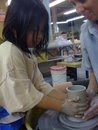
Nolen and Vander Putten state that "Educators see [action research] as a practical yet systematic research method to investigate their own teaching and their students’ learning in and outside the classroom."
This clay that teacher researchers center and then pull and shape together--their practice as teachers and the learning of their students--can be difficult to work with. When seeking to make a change--as we do in our classrooms through educational action research--it often feels like an immovable lump of hard clay. However, with a community of teachers and learners and family members as participants, the action researchers can center and really get a handle on what the real problems are. Potters add water and use their hands, ribs, and other tools to change the clay--to move it to a different position so that they can see what can be created from the initial lump. Teacher action researchers do much the same through the action and reflection cycle.
It's only after several cycles of action and reflection by both the educational action researchers and the potter that the real possibilities can be seen and the real change can begin.
I'm interested to know what images or metaphors you use to describe educational action research. What projects are you contemplating, initiating, researching now? Would you share those with us? Please feel free to share your thoughts here. You are also welcome to email me at dusty.embury@uc.edu if you'd like to write a post about action research in education.
Peace, Dusty
Subscribe to:
Posts (Atom)

 Posts
Posts


